Why I Decided to Lose Body Fat, and What I've Learned Along the Way
I've been doing CrossFit for years. I train regularly, I'm active, and I've always thought I had a fairly good understanding of nutrition.
But earlier this year, I found out I had fatty liver disease, also known as non-alcoholic fatty liver disease.
Now, I don't drink alcohol, and I train four or five times a week, so it was a bit of a wake-up call.
It made me realise that just because you're training regularly and keeping yourself fit doesn't necessarily mean everything is where it should be with your health.
So I decided to do something about it.
What I Wanted to Achieve
The main reason I started this wasn't really about losing weight.
It was about improving my health and reducing the amount of fat I was carrying, particularly around my internal organs.
This is called visceral fat, and higher levels are linked to health problems.
I also wanted to set myself a couple of goals.
The first was to get my body fat down to around 12%.
The second was to maintain my muscle mass, or ideally increase it.
Because the last thing I wanted was to lose a load of weight but also lose the muscle I'd spent years building.
I still wanted to train hard, lift weights and enjoy my CrossFit.
My Results So Far
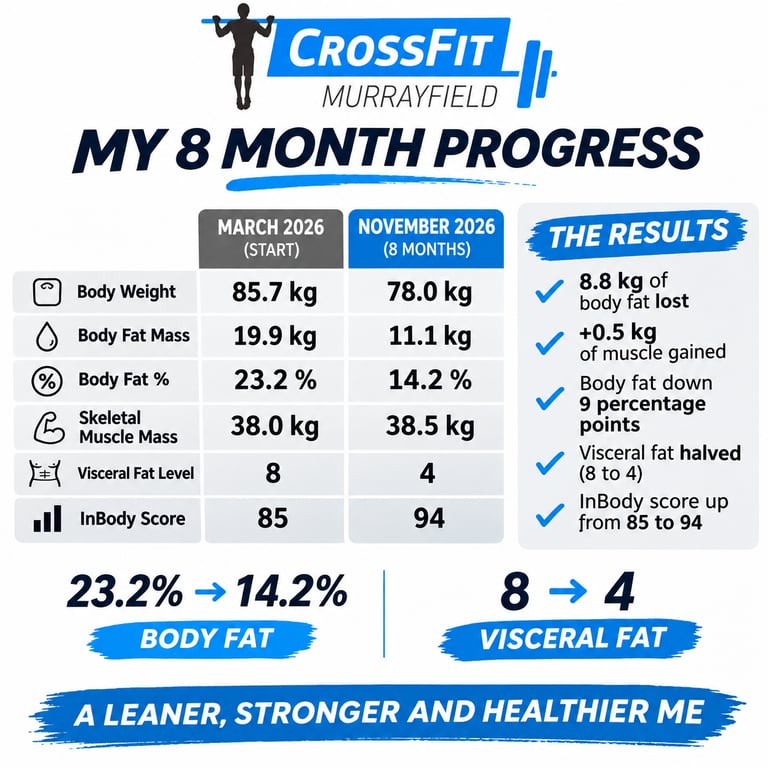
Back in March 2026, I started tracking my body composition using our InBody scanner at CrossFit Murrayfield.
And looking at the results eight months later, I'm pretty pleased with how things are going.
Measurement
March
November
Body weight
85.7kg
78.0kg
Body fat mass
19.9kg
11.1kg
Body fat percentage
23.2%
14.2%
Skeletal muscle mass
38.0kg
38.5kg
Visceral fat level
8
4
So, in eight months, I've:
- Lost 8.8kg of body fat.
- Reduced my body fat from 23.2% to 14.2%.
- Gained 0.5kg of skeletal muscle.
- Reduced my visceral fat level from 8 to 4.
- Lost 7.7kg in overall body weight.
I'm now only 2.2 percentage points away from my original 12% body fat target.
And probably the bit I'm happiest about is that I've managed to maintain and slightly increase my muscle mass while losing body fat.
These are estimates from the InBody scanner, so the numbers can fluctuate. But looking at all my scans, the overall progress is clear.
What Did I Actually Change?
The biggest change wasn't my training.
I was already doing CrossFit regularly.
The biggest change was paying more attention to what I was eating.
I've been using my Iron Will Nutrition app to help track my food.
One of the things I've said for years is that before you start changing what you're eating, you need to understand what you're eating.
And that's exactly what I've been doing.
With the app, I can take a photograph of my meals and get an estimate of the calories, protein, carbohydrates and fats.
It's not going to be perfect every time, but it gives me a much better idea of what I'm eating throughout the day.
And when you start looking at that information, you begin to notice things.
Portion sizes, extra snacks, how much protein you're getting, and whether you're eating more than you actually need.
I haven't followed some crazy diet.
I haven't stopped eating the foods I enjoy.
I've just become more aware of what I'm eating and made changes where needed.
Why I Think the InBody Scans Are Important
If I'd just been using the bathroom scales, all I'd know is that I'd lost 7.7kg.
But that doesn't tell me what I've actually lost.
Was it body fat? Was it muscle? Was it a mixture of both?
That's why I've been using the InBody scanner throughout this process.
It gives me an estimate of my body fat, muscle mass and visceral fat levels.
And for me, the visceral fat measurement has been particularly interesting because of my fatty liver diagnosis.
Seeing that number come down from 8 to 4 is encouraging.
Now, that doesn't automatically mean my fatty liver disease has gone away. Visceral fat and liver fat aren't the same measurement, and I'd need medical follow-up to know how my liver is doing.
But reducing excess body fat was one of the reasons I started, and I'm pleased with the progress.
It Hasn't All Been Perfect
One thing worth mentioning is that the results haven't gone down in a nice straight line.
There have been weeks when my body fat has gone up slightly.
My muscle mass has gone up and down as well.
And there have been times when very little has changed.
But that's why I think it's important to look at your progress over months rather than days.
One bad week doesn't mean you're going backwards.
It's what you're doing consistently over a longer period that matters.
Why I Use Iron Will Nutrition
One of the reasons I developed the Iron Will Nutrition app was to make tracking food a bit easier.
I wanted something that people could actually use without spending ages weighing every bit of food or trying to work out calories.
Take a photograph, get an estimate, and start understanding what you're eating.
But the app is only part of it.
There's also the coaching, regular check-ins, accountability and InBody scans.
Because it's one thing knowing what you're eating.
It's another thing understanding what to do with that information.
And that's where having a coach can make a difference.
What's Next for Me?
I'm not finished yet.
My original goal was to get down to around 12% body fat while maintaining or increasing my muscle mass.
I'm currently sitting at 14.2%, so I'm getting closer.
But I'm not in a massive rush.
I want to keep training, keep enjoying my food and continue making improvements.
More importantly, I want to keep improving my health.
That's the reason I started this in the first place.
And if there's one thing I've learned from the whole process, it's this:
Before you change what you're eating, understand what you're eating.
You might be surprised by what you find.
If you'd like to learn more about how we use nutrition coaching, the Iron Will Nutrition app and InBody scans at CrossFit Murrayfield, Eamil wull@crossfitmurrayfield.com